
With over thirty websites « serving the community, » the No Gods No Masters network attracts tens of thousands of daily visitors. Forums, illegal download platforms, militant content aggregators, counter-cultural event calendars: over the past fifteen years, this ecosystem has gradually expanded its influence within the militant digital landscape—quietly establishing itself without raising much scrutiny. Yet, far from the proclaimed « non-profit » cooperative model and transparency, everything indicates that a single individual stands behind this highly profitable constellation of websites.
A simple black t-shirt, bearing the encircled A. Price: from €22.50 to €43.39. The website makes a promise: « Every purchase helps raise donations for activist groups and charitable causes. » This is the compelling argument of No Gods No Masters (NGNM), a platform claiming to finance activist collectives and social movements through the sale of rebellion-branded merchandise. Yet, behind the screen, the reality is quite different.
A fictional « cooperative » serving a single individual
It all began modestly in 2004 with Resistance.tk, a small, homemade website founded by a Montrealer using the pseudonym AnarchOï. At the time, the « Resistance Network » was presented as a « tool for activists aimed at facilitating the organization of libertarian struggles, both locally and internationally. » The reality is far more mundane: although the forum has gathered over ten thousand registered members in twenty years, it has never amounted to more than a space where a handful of active users exchange more or less confused opinions.
In 2008, a new project emerged: platforms dedicated to music downloads. Quickly expanded into several languages and countries (Pirate-Punk, QuebecUnderground, Anarcho-Punk, etc.), these forums now boast over 125,000 members and provide around 33,000 albums available for illegal download, making them central hubs of music piracy within the « alternative » music scene. Though the declared goal is to promote underground bands, many artists—despite belonging to a scene known for its openness to music sharing—criticize the platform’s catalog-like approach. They assert their right to decide whether or not to distribute their works on the channels they choose. The network’s administrator, aggressive toward small independent bands, becomes notably more accommodating when copyright holders from labels demand removal of download links.
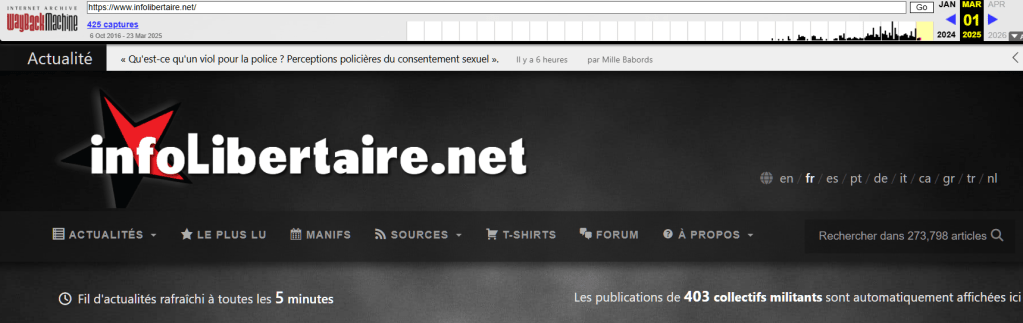
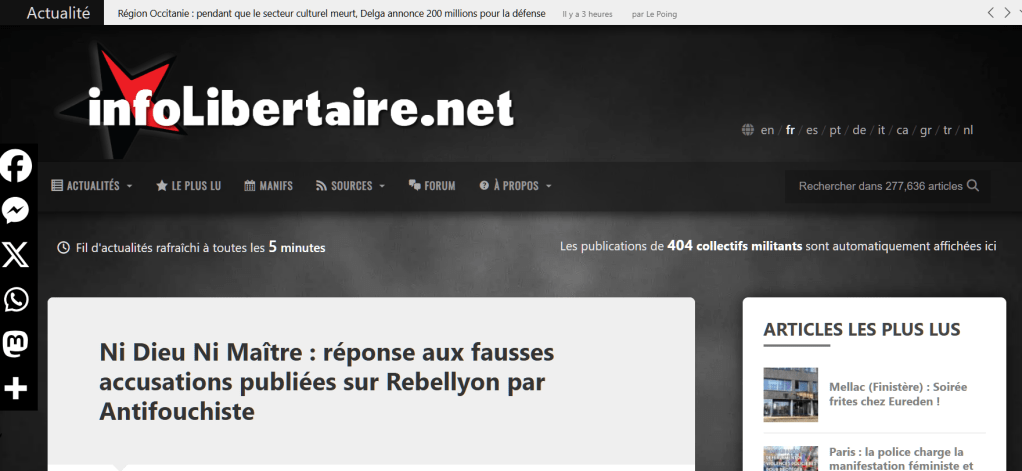
In 2016, AnarchOï launched InfoLibertaire, a content aggregator that automatically harvests articles from over four hundred activist sources using aggressive web-scraping techniques. Without prior moderation, the « harvested » articles are copied in full onto InfoLibertaire—a practice that frequently results in publishing reactionary, conspiratorial, or anti-LGBTQ+ content. Once duplicated and posted online, an army of bots spreads the articles across social media, redirecting readers not to the original sources but directly to sites branded by NGNM. « It’s an organized theft of activist labor, » critiques one activist who wishes to remain anonymous. « He claims to support our causes, but in reality, he instrumentalizes them. »
The visibility of the NGNM network is so dominant, and confusion regarding the origin of sources so deliberately maintained, that even major media outlets become confused. In 2017, for instance, the leading French television channel, TF1, incorrectly reported that the claim of responsibility for an arson attack on a garage within a police barracks in Grenoble had been published on InfoLibertaire, while the information was actually aggregated from Indymédia Grenoble. Similarly, in April 2024, La Dépêche (french newspaper) mistakenly stated that the arson attack on a 5G antenna was claimed on InfoLibertaire, when the original publication actually appeared on iaata.info, a member of the Mutu network (a cooperative of activist news sites).

Never shy about grandiose rhetoric, the founder and administrator of these projects portrays them as « collectives operating on principles of self-management » aiming « to organize and collaborate without the constraints and surveillance imposed by the interests of major corporations » In the months following its launch, InfoLibertaire expanded into 11 languages under the label « Anarchist Federation Network, » thus appropriating the identity of the International of Anarchist Federations. Behind this façade, there’s still no self-managed collective—just the same operational approach: automated aggregation of content produced by hundreds of genuine activist collectives.
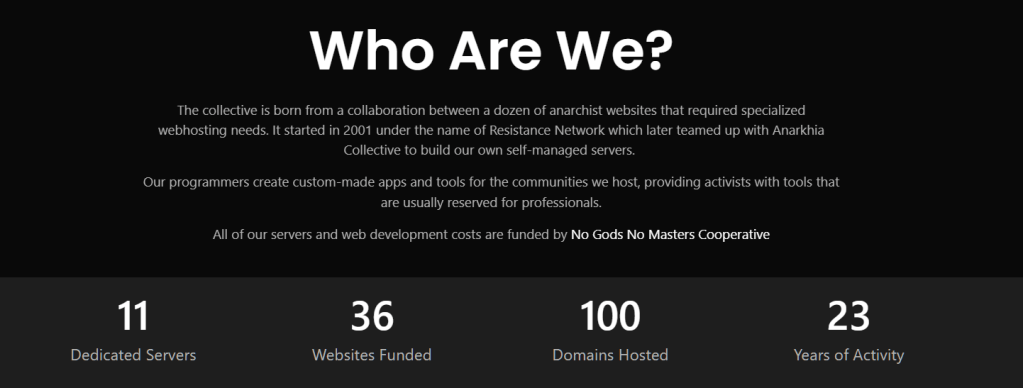
Today, the ecosystem consists of ten servers powering 36 websites, 15 newsletters, and fully automated activist and cultural event calendars. The network is maintained and developed by a mysterious Tech Team No Gods No Masters, with AnarchOï as its sole visible spokesperson. This infrastructure is funded by a purported cooperative, without legal existence, named No Gods No Masters, behind which, once again, only AnarchOï publicly appears. This cooperative generates revenue from five online stores specializing in « militant » clothing and accessories featuring logos and slogans drawn from popular culture and social movements. These stores are also the creation of AnarchOï, as evidenced by his announcements on the Résistance and Pirate-Punk forums, as well as his interactions over the years on developer-oriented technical support platforms.
It was in 2010 that AnarchOï launched the No-Gods-No-Masters online stores, imposing advertising banners across all forums on his community and volunteer moderators. Faced with internal criticism, he reacted violently: « Those who opposed this commercialization were expelled without hesitation, ironically accused of abusing power, » recalls a former moderator banned at the time. AnarchOï didn’t leave much room for debate, even threatening to shut down the sites: « He presented it to us as the only possible option, assuring us that donation campaigns weren’t sufficient to cover the network’s costs. » When the community requested transparency to evaluate possible alternatives, the administrator—who controlled everything—refused to disclose financial details or quantify actual needs. Fed up with « vagueness, lies, and slander, » some members abandoned ship, while those who remained committed to their community and the forum they had maintained for years eventually saw their access revoked. Since then, all network sites prominently feature the « t-shirts serving the cause » on every page.
Activist Dropshipping
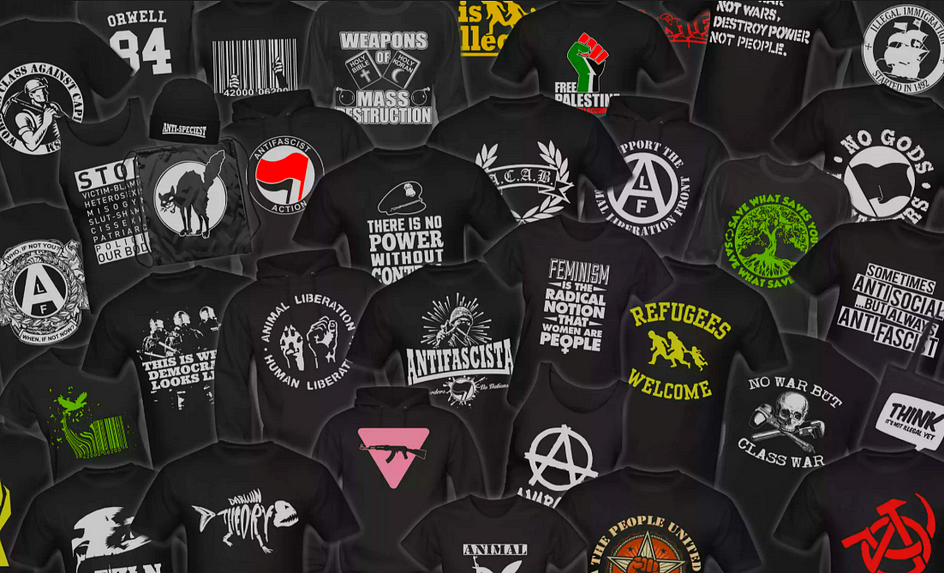
Available in five languages, the stores position themselves as production tools serving activist organizations and struggles. On the No-Gods-No-Masters blog, discussions revolve around « supply chains, » « suppliers, » « rising cotton prices, » and increasing energy costs—material considerations that seem to validate the notion of a business firmly rooted in the textile and fashion industry.
Every product you order here is individually handmade just for you
The production model is presented as virtuous: « Our militant cooperative isn’t some cheap t-shirt supermarket encouraging overconsumption; we don’t keep any products in stock. » Printing is done « on demand and handmade specifically for you, » promising « zero-waste production and sustainable development. » However, beyond the purported ecological and social benefits, print-on-demand primarily provides a significant strategic advantage: the ability to offer « an almost unlimited catalog of designs and products » instantly connected to activist news disseminated by the NGNM network. Black Lives Matter, Palestine, LGBTQ+—featured products closely track social movements and current events. The boutique’s website openly admits to using the logic of overconsumption it otherwise denounces as an ethical argument: « The more diverse our catalog, the more we achieve our fundraising goals for activist causes. » Behind these statements, which attempt to obscure the economic reality with the rhetoric of « ethical and militant business, » lie the well-established mechanisms of the textile industry and digital capitalism: dropshipping and fast fashion.
Even worse, to better deceive consumers, the network’s administrator deliberately fosters confusion, if not outright dishonesty. Thus, on its blog, the shop claims to « share its production resources out of militant solidarity, » presenting garments as printed on « our Kornit Atlas printers. » Too bad for the casual visitor or activist-customer if, in reality, these printers and production resources belong to SPREAD GROUP, the multinational boasting « 20 million customers » and a « €175 million turnover »! Behind the reassuring speeches and staunchly activist tone lies a far less flattering truth: this website is ultimately just one among 250,000 affiliate stores of Spreadshirt, the well-known personalized clothing giant.
I received a Fruit of the Loom t-shirt made in El Salvador by Spreadshirt
The rhetorical tricks saturating the store’s website—lengthy texts filled with half-truths and deceptive promises—are particularly effective since visitors arrive through a militant network considered trustworthy. Indeed, part of the site’s traffic is funneled from the 35 other websites within the constellation. Yet, beyond the homepage’s enticing promises, several red flags should raise suspicion. These long arguments touting exemplary “working conditions” and “ethical” and “eco-friendly” production copy, word-for-word and without critical reflection, the textile industry’s marketing rhetoric. Another revealing example: in 2023, NGNM proudly announced “100% carbon-neutral shipping,” claiming that “it’s something we’ve been working toward for a long time.” In reality, this statement nearly exactly replicates official communication from Spreadshirt to its affiliates. The trick is obvious: clearly, a small shop has no control over the carbon neutrality of global logistics chains. By adopting empty greenwashing promises from multinationals, NGNM primarily sells the illusion of its own autonomous existence. Ultimately, the supposed added value offered to the customer boils down to paid access to a database of militant logos and slogans, already widely available online for free.
It is only after placing an order that the most attentive customers discover the truth, printed on their invoice or delivery slip. This unpleasant surprise unsettles some customers, shocked to find in their mailbox a Fruit of the Loom t-shirt, made in Central America and shipped by Spreadshirt. On the website itself, only careful scrutiny of the privacy policy reveals discreetly that among the “third parties collecting information” are PayPal and Spreadshirt. The multinational is mentioned only once more, on a page titled “Ethical Standards: Manufacturers’ Code of Conduct and Working Conditions.” It is only here that one learns that SPRD Inc. (Spreadshirt) is actually the « exclusive manufacturing partner » of NGNM.
Plastic Ethic
Under a barrage of pompous certifications—Worldwide Responsible Apparel Foundation, Vérité Fair Labor, Empowering Ethical Supply Chains, Ethical Trade Audit, California Safety Compliance Corporation, Business Social Compliance Initiative, Social Accountability 8000, Oeko-Tex Certification—the supposed « ethical charter » from SPRD Inc, fully published by No Gods No Masters, struggles to convince. The multinational portrays it as a groundbreaking achievement that subcontractors must simply comply with « local production laws. » Between hollow declarations about « dignity » and « equality, » one discovers, without irony, that these supposedly exemplary conditions include workweeks of up to « 60 hours » spread over « six days, » and that wages offered do not exceed the strict local legal minimum. One must question how merely complying with some of the weakest social and environmental laws in the world could possibly be considered ethical—yet this charade is relayed unquestioningly by the so-called « cooperative » NGNM. Following the same pattern of uncritically appropriating pseudo-ethical rhetoric from major corporations, NGNM even proudly states on its website: « We endorse the Responsible Sourcing Network coalition against forced labor in Uzbekistan. » A stance that boils down to mechanically reproducing the greenwashing practices of its supplier, SPRD Inc. Activists, artists, multinational corporations—at NGNM, everything is fair game for copying, as long as it fills the virtual shelves and very real coffers of ready-to-wear activism.
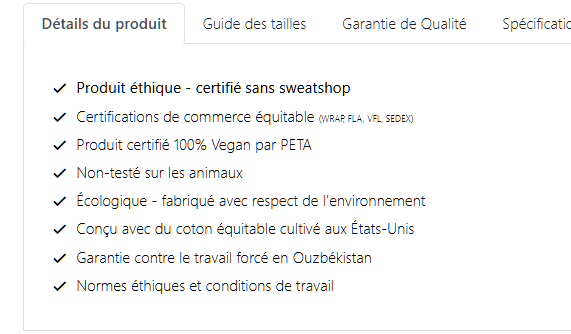
NGNM even boasts about exclusively using American cotton, reproducing verbatim on its blog a page directly from the textile giant Fruit of the Loom, proudly highlighting its boycott of Uzbek cotton. Yet, in 2023, international media exposed Fruit of the Loom—an official subcontractor for Spreadshirt—for involvement in a major scandal involving brutal and systemic exploitation of isolated migrant children.
To better sell its t-shirts, No Gods No Masters prominently displays various certifications intended to guarantee ethical production, notably PETA’s « vegan » label. In reality, the license was paid for only one year before being discontinued, yet the logo still features prominently on product pages.
Low-cost servers,premium profits
On its website, NGNM assures visitors that the money generated from sales finances the network’s technical infrastructure. Yet, once again, just as with its store, ambiguity is carefully maintained. The wording cleverly implies that NGNM manages its own servers. However, a quick reverse DNS check reveals that all sites are actually hosted by OVH. Although this information can be found on the site, it only appears in obscure subsections, far from the carefully crafted narrative featured prominently on the homepage. While the exact infrastructure costs are difficult to estimate, a screenshot posted on a forum by AnarchOï provides some insight into an order for a new server placed with OVH. It shows that, to host three of his sites, the administrator rents low-end equipment costing just €16.99 per month.
The « cooperative » repeatedly claims to provide free hosting solutions for around a hundred activist websites. Curious yet skeptical, we reached out to several of the 400 sites scraped by InfoLibertaire, assuming logically that this would be the most likely place to find confirmation. So far, no evidence has emerged. Although it’s impossible to entirely exclude the possibility that this infrastructure hosts sites outside the NGNM ecosystem, as always with AnarchOï, there is no proof supporting this assertion. Once again, we are left only with his word—the word of an administrator known for approximations, flashy announcements, and flexible interpretations of reality.
To support the cause, No Gods No Masters claims it donates all remaining profits, after funding the Résistance Network, to militant associations and NGOs. Yet, without any guarantees other than its founder’s word, a close examination of announced donations reveals a far less generous reality: just a few thousand euros distributed over more than a decade. One could perhaps assume that the NGNM administrator, struck by unusual modesty, chose not to disclose the full extent of donations made; nevertheless, the publicly reported amounts remain negligible compared to the substantial profits accumulated over fifteen years.
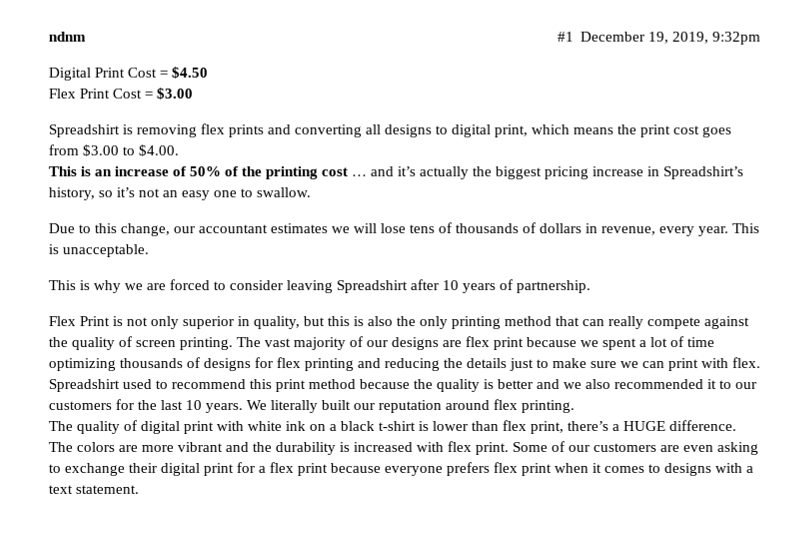
A forum screenshot concerning Spreadshirt’s printing cost increases sheds further light. In a heated exchange discovered in 2020 on a Spreadshirt seller-support forum, AnarchOï strongly criticizes the company’s new pricing policy, complaining that a one-dollar increase per t-shirt print would result, « according to his accountant, » in « tens of thousands of dollars » of annual profit losses. Taking the storekeeper at his word, this suggests annual sales of t-shirts, hoodies, and other merchandise totaling tens of thousands of units. Additional details clarify these estimates. According to messages published (and later deleted) on a forum, the cooperative was selling approximately 2,400 t-shirts per month in 2020. With an average profit of $8.77 per shirt, this would represent a comfortable annual income of about $250,000.
A Virtual Kingdom with Blurred Boundaries
No legal disclosures, no commercial transparency—legal opacity is meticulously maintained. On some websites in the NGNM galaxy, such as ConcertsPunk.fr—which automatically aggregates announcements of militant concerts—AnarchOï refers to two distinct entities: PunkShows LLC and NGNM LLC, allegedly registered in New Mexico. However, a check in the state’s official records reveals that these entities do not exist. A company named NGNM LLC was indeed registered in February 2023 in North Canton, Ohio, but the registration documents were signed by a statutory agent, a third party designated to act as the official administrative contact—a mere formality that in no way implies actual ownership. The trail stops there.
Beyond structural inconsistencies, the network’s operation raises numerous questions. Some have already been highlighted on internal forums and public discussions. Any questioning or criticism triggers fierce attacks, sometimes even threats of legal action. AnarchOï, for instance, does not hesitate to exploit American copyright law (DMCA) to demand that Google remove search results pointing to critical pages, cynically claiming they infringe upon his intellectual property rights.
No Gods, No Masters… No Scruples
The system established by AnarchOï relies on a simple yet ruthlessly effective logic: plunder, redirect, cash in
Activist content, artistic productions, articles, and analyses from activist collectives—everything is systematically harvested on a large scale using automated scraping and RSS aggregation, a protocol that automatically retrieves newly published web content without manual review. There is no sorting, no editorial oversight, no mutual agreements: publications are duplicated across the NGNM network’s sites, always accompanied by advertising banners leading directly to the online stores.
An army of bots then spreads this content on social media, their posts never linking to the original sources but always pointing back to sites within the NGNM galaxy. The result: a steady influx of captured traffic, strengthened authority in search engine rankings, SEO bolstered by exploiting activist labor—and an online shop prominently displayed at the bottom of each page.
Everything is carefully engineered to sustain itself. Hijacked content drives traffic; traffic fuels the boutique; the boutique finances the network. It’s a tightly sealed, profitable loop managed by a single individual, who masterfully portrays himself as operating a « non-profit » cooperative, while in reality capitalizing on the struggles and labor of others.
This well-oiled system rests on a meticulously crafted and maintained illusion: nonexistent collectives, token donations, fictitious ethical certifications, phantom companies, and total opacity. At a time when legitimate criticism increasingly targets those who convert activist struggles into symbolic capital and economic rent, the Resistance Network stands as a textbook example of the cynical, mercantile exploitation plaguing militant circles.
Addendum: A significant cleanup is underway across the NGNM galaxy of sites. On March 14, the day before our initial alert was published on a Bluesky thread, banners and advertising displays still saturated the pages of the relevant websites and forums. By the very next day, ads had been removed from the French-language sites—a troubling coincidence allowing the network’s administrator to declare, “the article [by the Action Antifouchiste collective] conveniently fails to mention an important fact: as of today, there are no advertisements on InfoLibertaire or on the forums.” Apparently, absurdity has no limits.

En savoir plus sur Action Antifouchiste
Abonnez-vous pour recevoir les derniers articles par e-mail.
 Action Antifouchiste